New Publication
Precipitation Shifts for Major US Watersheds
Precipitation Shifts for US Watersheds outside the historical range
Posted by Jim Stagge on July 15, 2025
Access the paper: Pre-Industrial and future shifts in seasonal precipitation climatology for large river basins across the continental U.S.A
I am pleased to announce the publication of our recent study titled “Pre-Industrial and future shifts in seasonal precipitation climatology for large river basins across the continental U.S.A”, which explores how precipitation patterns have shifted over the past millennium and the expected changes in the coming decades.</p>
Key Findings
- The study analyzes seasonal precipitation trends across U.S. watersheds from 850 CE to 2100 CE.
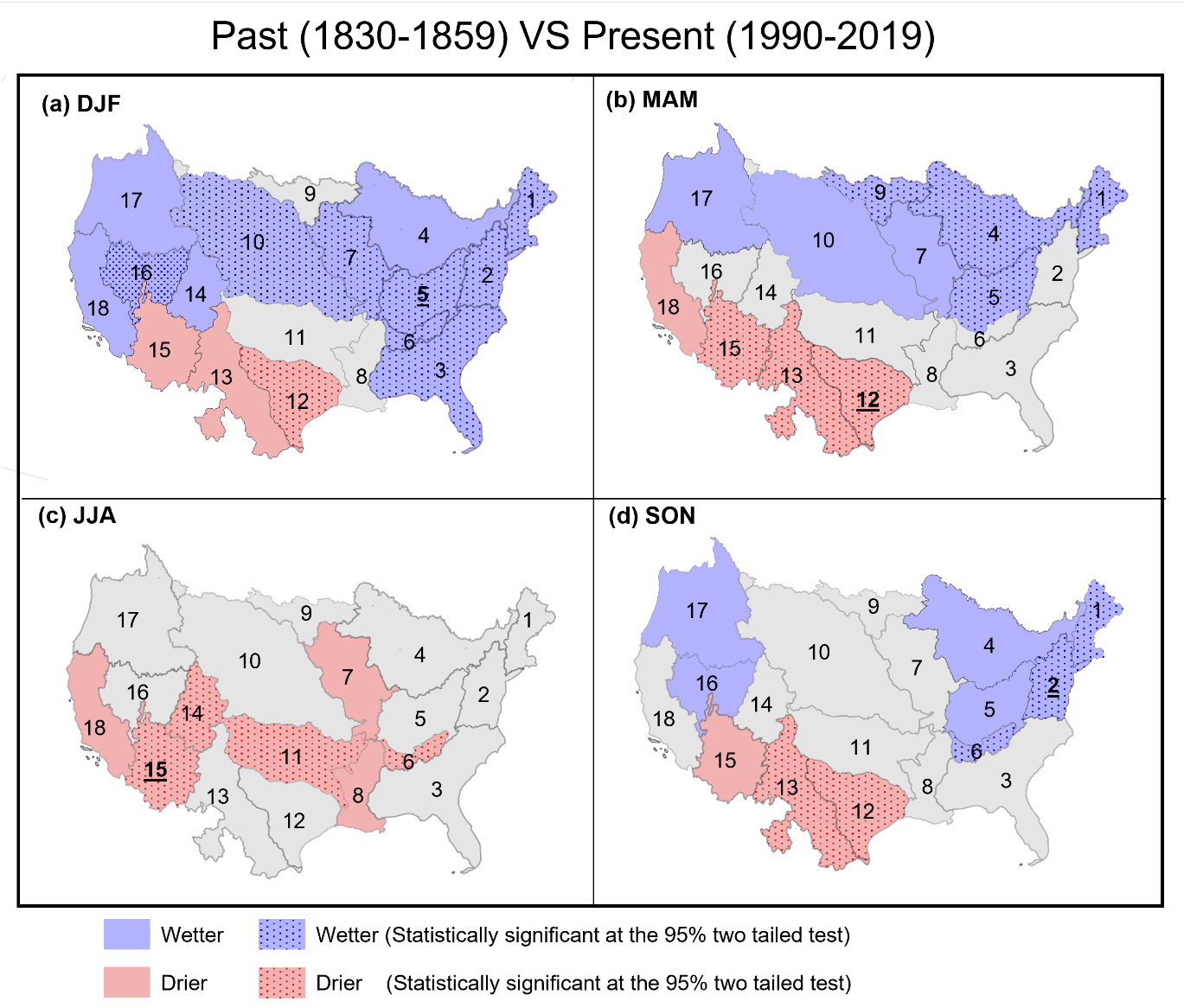
- Post-1850 trends show wetting in northern and eastern regions, while southwestern areas have seen intensifying drying trends.
- Seasonal variations reveal the most significant changes during winter and spring, with the drying trend expanding across the U.S. in summer.
- Precipitation shifts have surpassed pre-Industrial variability in many watersheds, indicating the influence of human-driven climate change.
- The findings highlight the need for water resources management to adapt to these ongoing shifts in precipitation patterns.
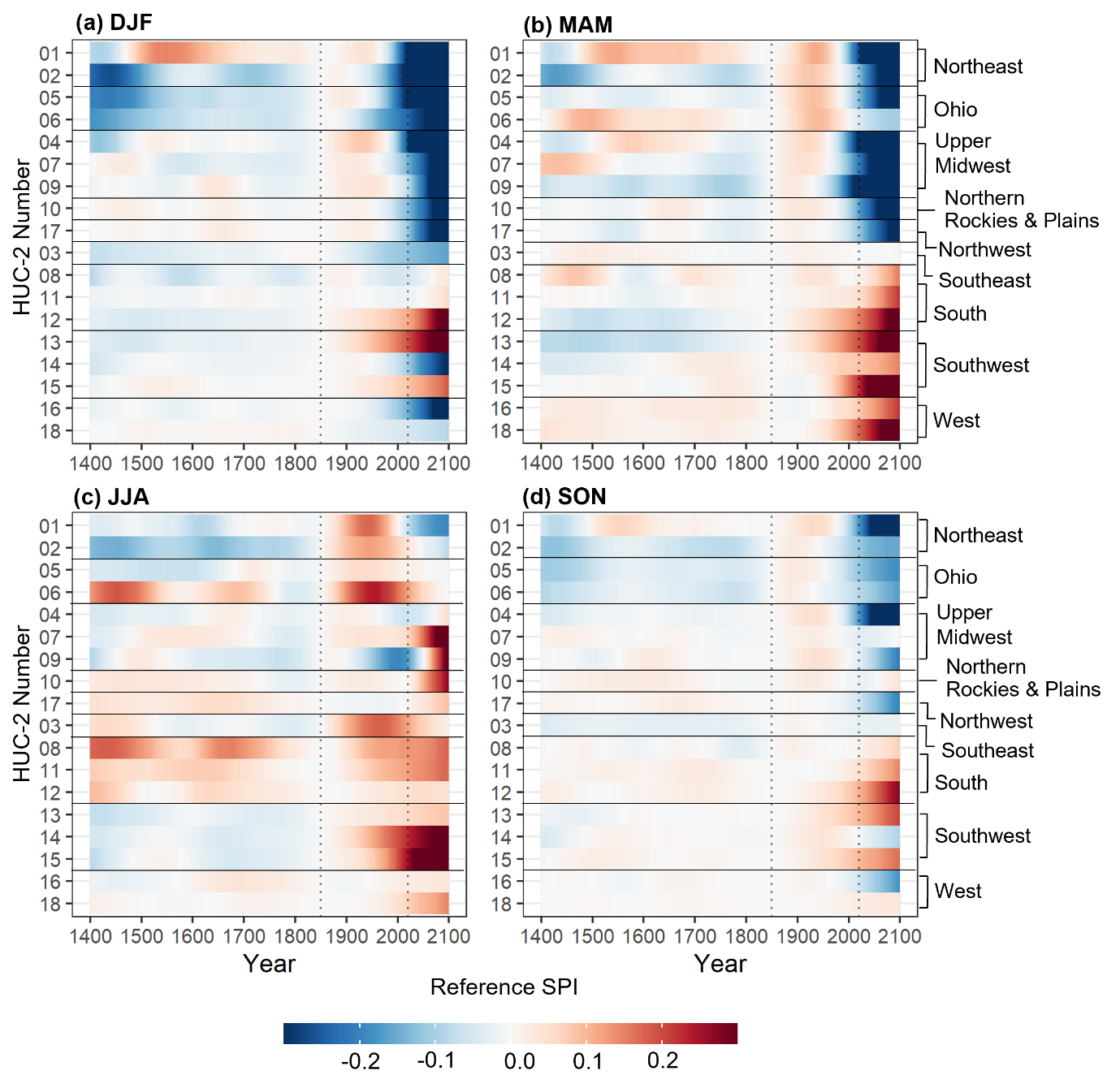
Heat maps of relative SPI-3. The color represents the median of all grid cells within each HUC-2 region. The color scheme mirrors Figs. 1 and 2, with red indicating drying trends and blue indicating wetting trends. Watersheds are reordered based on location. Vertical dotted lines mark the year 1850 and 2020, respectively.
Implications
The study highlights the importance of adapting water management systems to the changing climate. With shifting precipitation patterns, regions experiencing wetter conditions may face more frequent floods, while drier areas will be at greater risk for water scarcity. Water managers will need to reassess infrastructure and operational strategies to mitigate these risks, ensuring sustainable water availability in the face of future climatic shifts.
Read the full study
For more information and to access the full study, visit Geophysical Research Letters.
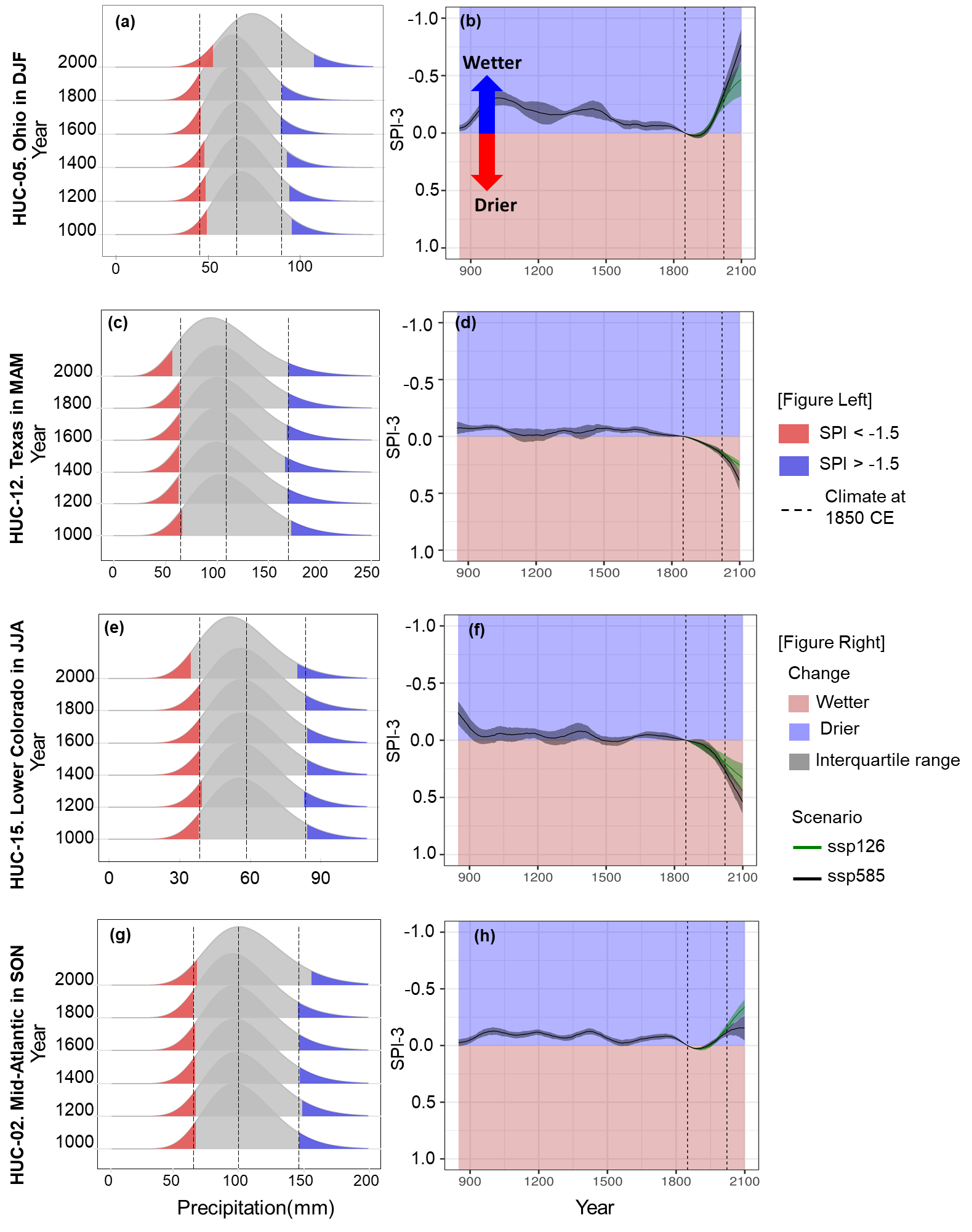
(Left) Fitted Gamma probability distributions calculated in every 100 years period starting from the year marked in y-axis. (Right) The time series of relative SPI-3. Each row corresponds a different basin and season.
Abstract
This study investigates seasonal precipitation trends across major watersheds in the continental United States over the past millennium (850 CE) and into the projected future (2100 CE). Using a non-stationary Standardized Precipitation Index (SPI) model, we quantify shifts in median precipitation climatology relative to an 1850 pre-Industrial baseline, integrating modern observations, tree-ring reconstructions, and climate model simulations. Trends at a gridded scale were then summarized by HUC-2 watershed to produce relevant results for water resources planning. Results show that northern and eastern watersheds have experienced wetting trends in the modern, Industrial era (post 1850), while southwestern regions have undergone intensifying drying trends, particularly during the summer. Trends vary seasonally, the most distinct north-south division occurring in winter and spring, while the region of increased drying expands to cover most of the U.S. during the summer. These trends are projected to continue on their current trajectory through the end of the century. By placing modern and projected precipitation trends into a multi-century historical context, we show that the magnitude of modern trends has exceeded pre-Industrial variability in many watersheds, suggesting the role of anthropogenic climate change in precipitation shifts. This study emphasizes the importance of adapting water management systems to ensure sustainable water availability under evolving climatic conditions. For example, the findings can inform water resources managers when reassessing water infrastructure and operations to mitigate the potential of increased flood risks in wetting regions and heightened water scarcity in drying areas.